Lawrence ranks in top ten for distressed properties, a precursor to bankruptcy

A Massachusetts housing recovery is still a long way off, according to an article in the Boston Globe.

And Lawrence ranks in the top ten communities in Massachusetts in the number of distressed properties — that is, homes where the owners are substantially behind on mortgage payments. A rise in the number of distressed properties is often a sign of increased bankruptcy filings to come.

On the other hand, full-fledged foreclosures are declining. Steve Bennett, a foreclosure prevention counselor, said he has noted a drop in the number of calls from financially stressed homeowners. He believes it’s partly due to a long-awaited effort by banks to help more homeowners with loan modifications. But Bennett said he knows the economy has not improved enough to make the issue go away.

Lewis Finfer, executive director of the Boston housing advocacy group Massachusetts Communities Action Network, said in the article that “homeowners appreciate the extra time to get their finances in order while lenders work out their procedures.” But he said they worry that they’ll never get enough help to ultimately save their homes. “People feel the sword is hanging over their necks,’’ he said.


By Doug Beaton

Posted in Bankruptcy News | Comments closed

Massachusetts bankruptcy blogger turns to working for the bankruptcy court

Fellow Massachusetts bankruptcy blogger Bill McLeod has shut down his blog. But its not for lack of interest or traffic, but because he has taken a job with the Bankruptcy court itself — as the court’s “pro se law clerk.”

What does a pro se law clerk do? There are only a few of them around the country, but basically their job is to make sense out of the papers and pleadings filed by pro se debtors — people who are filing without an attorney.

I don’t know this for sure, but my intuition is that Bill’s new job will entail reading a lot of lawsuits from people trying to get a hardship discharge for their student loans. This requires debtors to prove their own hardship circumstances by filing a lawsuit against the student loan lenders. They usually have no attorney, because if they had the money for an attorney, they wouldn’t be in hardship mode. So instead they end up having to learn the ins and outs of civil procedure on the fly — all while up against a savvy opponent such as Sallie Mae.

Attorney McLeod will undoubtedly spend much time trying to unravel their tangled pleadings, trying to get the judge to understand what they are trying to say. It won’t be an easy job — but he asked for it!

The pro se law clerk also puts together clinics around Massachusetts for people who are considering filing for bankruptcy without a lawyer. I’m not suggesting you do this — hey, I’m a lawyer! — but if you are bound and determined, attending one of these clinics should be worth the time.


By Doug Beaton

Posted in Bankruptcy News | Comments closed

Chapter 7 Bankruptcy without paying the filing fee

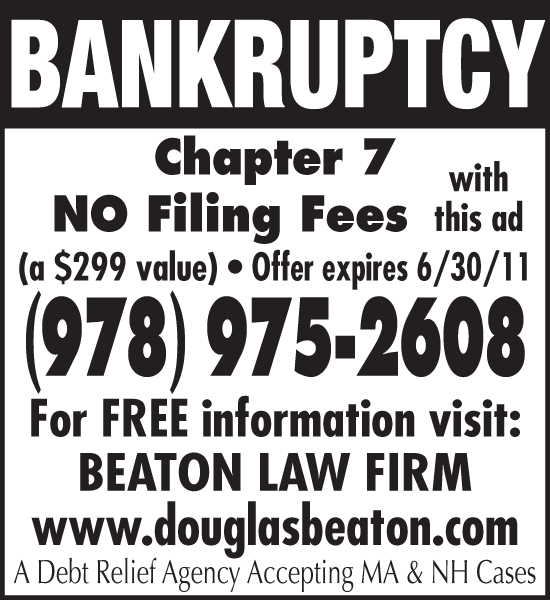
If you pick up the Lawrence Eagle-Tribune on Tuesday or Thursday, you’ll find an ad like the one at left which can be used as a “coupon” for a reduction of $299 off of a Chapter 7 bankruptcy case during the month of June. That’s like being able to file without paying a filing fee! Full details are found here.

I am running this offer through the month of June, and it is available for persons in both Massachusetts or southern New Hampshire who are looking to get a fresh start through a Chapter 7 bankruptcy case.


By Doug Beaton

Posted in Bankruptcy News | Leave a comment

New Massachusetts bankruptcy exemptions chugging along smoothly

The new Massachusetts bankruptcy exemptions, which were introduced in early April, seem to have been accepted by the bankruptcy community without much fuss. I know I filed several cases using Massachusetts bankruptcy exemptions and have had no trouble at all — the cases flew right through the system.

When the changes took effect, for the first time Massachusetts has a “wild-card” exemption, which for most individuals amounts to $6,000 in protection. Absolutely any type of property — even cash — can be kept after bankruptcy by using the wild card.

This hasn’t necessarily been the case elsewhere when new exemptions are introduced. A few years ago, Florida introduced a $4,000 wild card, and the bankruptcy trustees went nuts trying to find loopholes and poke holes in the new law. They were apparently used to collecting $1,000 commissions whenever a Floridian had non-exempt property in their bankruptcy, and were not happy to see that source of income disappear. However, after several years of litigation, the courts eventually sided with the debtors anyway.

I’m glad that hasn’t happened in Masschusetts. So far.

And by the way, the most common reason for using the Massachusetts exemptions instead of the federal ones when filing for bankruptcy? It’s to protect home equity, as up to $500,000 per person in home equity can be exempted using the Massachusetts homestead law.


By Doug Beaton

Posted in Exemptions | Comments closed

The cardinal rule of personal bankruptcy — list it or lose it!

Sometimes dealing with legal matters is like walking through a minefield of complexity — court opinions that don’t agree, statutory language that can’t be figured out even with a law degree, and all that legalese that applies as soon as you click “accept.”

In the bankruptcy courts, however, there is one cardinal rule that is pretty easy to understand — list it or lose it!

All of your assets need to be declared if you are going to file a bankruptcy petition. It’s as simple as that. Failure to include assets mean they are automatically forfeited to the bankruptcy trustee who will sell them on behalf of your creditors — even if you could have protected them otherwise. Plus you could be made to pay a penalty (not good if you are in need of bankruptcy protection) or in an extreme case, face the wrath of the criminal law.

On the other hand, declaring your assets allows you and your bankruptcy attorney to seek ways to protect them, principally by using up all available exemptions recognized by either the federal, Massachusetts, or New Hampshire governments.

If a particular asset can’t be protected entirely, sometimes it can be protected partially. In that case, you may be able to “purchase back” the non-exempt portion from the trustee. Or some people may be able to consider Chapter 13, where you keep even the non-exempt property, but make monthly partial payments to your creditors. In other cases, an asset that can’t be protected may not be considered worth selling by the trustee, and simply “abandoned,” which means you get to keep it anyway.

So list all your property, and don’t lose it!


By Doug Beaton

Posted in Practical tips | Comments closed

Chapter 13 Tests

Thinking about a Chapter 13 bankruptcy case? Before you can file a case under this chapter of the bankruptcy code, there are a number of “tests” a debtor must pass. Here’s a way to keep track of them all:

Debt limits: Chapter 13 has upper debt limits, but no lower limits. The current upper limits are $1,081,400 for secured debts, and $360,475 for unsecured debts. So you can actually have too MUCH debt for this chapter. The requirement is intended to funnel large business bankruptcies into Chapter 11.

Regular income test: You (or your spouse) will need to have some sort of regular income which which to fund a Chapter 13 plan. The “regular” income doesn’t have to be form a salaried or hourly job, but it shouldn’t be too erratic. Business income can count as regular, even though it varies.

Chapter 13 “means test:” If your household income is above the state average, a string of calculations are applied to you income to determine your minimum monthly plan payment.

Disposable income test: Here, you must determine a monthly budget, and commit your “disposable income,” — what’s left over after paying household bills going forward — to your plan as payment amount. Your disposable income needs to be equal to or greater than the means test figure.

Best interest of the creditors test: if you have property that is not exempt from attachment it will be forfeited in a Chapter 7 case. In a Chapter 13 case, you keep that property, your plan payments have to exceed the value of what your creditors would have received in Chapter 7.

Good faith test: this is a touchy-feelie one. If a judge finds that you didn’t file the case in “good faith,” but perhaps for the purpose of delay, he can dismiss the case.


By Doug Beaton

Posted in Chapter 13 | Comments closed

Bankruptcy and divorce: can the bankruptcy court step in and re-do your divorce settlement?

Bankruptcy and divorce — those handmaidens of a whopping mid-life crisis — are serviced by competing court systems with competing and confusing rules and requirements. Here is a guide to (at least partially) untangling the mess.

First, since 2005 there has been a notion in the bankruptcy courts of something called a “domestic support order,” often given the government-style acronym “DSO.”

In the old days, this was called “child support.” It isn’t dischargeable in bankruptcy then or now. In fact, arrears are treated as priority debts, which means they must be paid off . . . with priority. The real kicker is that the expansion of child support into DSO and its broader definition has sometimes spawned creative litigation about what is a DSO and what isn’t. For example, are attorney’s fees for fighting over support issues in Family Court a DSO, too.  You would be surprised at some of the answers judges have given to that one!

Now, what about purely property settlements? In the old days (before 2005, that is) sometimes these could be altered or eliminated with a Chapter 7 bankruptcy case. No more — now all debts to a spouse, former spouse or a child, incurred in connection with a divorce or separation are non dischargeable in Chapter 7.

But there may be a loophole (and you know how much lawyers like loopholes)! It’s called Chapter 13, where the Chapter 7 rules don’t necessarily apply. Specifically, all debts provided for by a Chapter 13 plan are dischargable, with certain exceptions . . .and the Chapter 7 property settlement exception isn’t one of them.

If you are troubled by a property agreement in a divorce case that doesn’t seem right, it might be worth checking with a bankruptcy attorney to see if you would be a good candidate for Chapter 13, which could supply an effective solution.


By Doug Beaton

Posted in Chapter 13, Chapter 7, The Bankruptcy Code | Comments closed

If you are going bankrupt, why are you worried about your credit score?

One of the most perplexing things a bankruptcy attorney can come across is clients (and potential clients) who are overly obsessed about their credit scores.

With some folks, its almost as if the FICO score itself is some sort of IQ number, indicative of intelligence, self-worth, or some other positive attribute.

If you are thinking of bankruptcy because bills have gotten out of control, the last thing you should be worried about is exactly what your credit score is.

One of the worst things for a credit score is having many late payments. Once your score is ruined this way, you might find that in a few months after filing for bankruptcy, your credit score is actually higher, because you now have no more unsecured debt to pay off.

If you get in the (good) habit of paying off your bills again after you file a bankruptcy case, you should have little to worry about, as your credit score should begin rising within a year.


By Doug Beaton

Posted in Credit cards, Practical tips | Comments closed

Massachusetts foreclosures up a bit; bankruptcies perhaps to follow?

There has been an uptick in foreclosure petitions filed in Massachusetts recently, although it appears to have housing experts baffled as to what, if anything, that might mean.

According to the Boston Globe, fourteen percent more foreclosure petitions were filed in April than in March. Foreclosure petitions signal the start of the foreclosure process, with the lender applying to a court for permission to hold an auction. The actual auction sale comes later.

April had the highest rate of filings since last September. This could represent lenders coming to grips with new laws put in place last years mandating longer waiting periods before resorting to foreclosure.

On the other hand, it could also just be gloom and doom in the economy. “Banks are picking up their foreclosure activity,’’ said Nadine Cohen, a managing attorney with the Greater Boston Legal Services, a nonprofit that works with low-income clients. “The economy is never going to improve until we deal with the foreclosure crisis.’’

Barry Bluestone, dean of the School of Public Policy and Urban Affairs at Northeastern University, saw it differently — he thinks the economy is picking up a bit: The local economy is starting to improve, he said, something which should help limit the number of foreclosures in Massachusetts. Instead of a warning, Bluestone saw good news in yesterday’s foreclosure data.

“During the rest of this year we should continue to see foreclosures at a reasonable low level,’’ said Bluestone. “It is another piece of statistical evidence which gives me some greater confidence in the Massachusetts economy.’’

My own take on this is that the economic collapse of 2008 may now have reached equilibrium, with housing prices stable but low, and foreclosures routine, but not at panic levels, and bankruptcy filings following suit.

As a bankruptcy attorney, however, one thing I do know for sure: A bankruptcy filing will still stop a foreclosure sale cold, and although I can never recommend procrastination, my office has gotten some of them filed in as little as 48 hours before the scheduled sale.


By Doug Beaton

Posted in Bankruptcy News | Comments closed

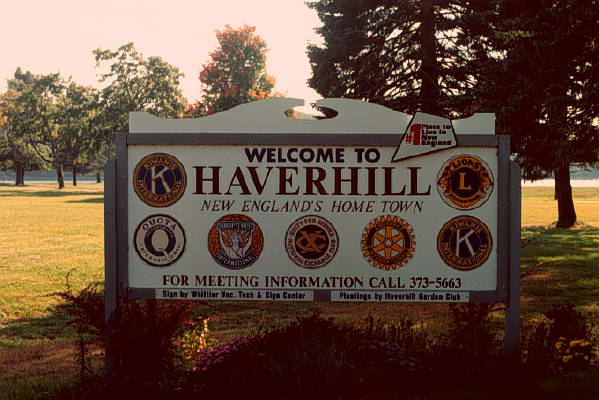
No famous bankruptcies in Haverhill?

For some blog posts, I was looking around for famous or important bankruptcy cases arising out of Haverhill, Mass. — and sort of came up empty!

Lawrence and Methuen hit the news with the Malden Mills fire and that firm’s subsequent bankruptcy. The Andover and North Andover areas were bankruptcy central for a few years when the tech CEOs living there got hit by the dot-com bubble bursting.

But Haverhill has largely avoided any bankruptcy headlines. Plenty of “ordinary” citizens file there, of course. Haverhill attorney Anthony Rozzi told the Boston Globe back in Febuaury that he didn’t expect to see any slack in future bankruptcy filings either.

As for the big national bankruptcy cases, they appear to have avoided Haverhill as well. Borders never had a store there, and the local Blockbuster outlet appears to be still in operation.

All in all, Haverhill bankruptcy cases seem to be comprised of the routine, rather than the extraordinary, which is probably all for the better!


By Doug Beaton

Posted in Just for fun | Comments closed
Call now: (978) 975 - 2608