Debtors take it on the chin trying to get rid of second mortgages

The Bankruptcy Code has a well deserved reputation for favoring consumers who litigate under it, but that doesn’t mean that consumer debtors win every case or every argument.

A group of Florida debtors were handed a significant loss last week in their attempt to “strip off” second mortgages on their underwater homes.

U. S. Bankruptcy Judge Karen Jenneman ruled that while strip-offs are legal in Chapter 13 cases, they cannot be done in Chapter 7 cases. This is significant because Chapter 7 cases are usually quicker and cheaper for debtors, and not every consumer can qualify for Chapter 13.

The case is reported as In re Hoffman, and actually involved ten separate debtors from Orlando, each with the same fact pattern: the debtors were homeowners whose property values had sunk below the amount due on their primary mortgage, leaving second (and third) mortgages apparently unsecured. The debtors filed Chapter 7 bankruptcy cases, and then had their lawyers file motions to remove the “junior” liens.

Judge Jenneman, however, relied on language from the 1992 Supreme Court case of Dewsnup v. Timm, to hold that the liens can’t be stripped without filing a Chapter 13 case. The ruling delves deeply into controversial interpretations of bankruptcy code section 506, which has confused lawyers for more than 30 years with its tortuous definition of what an “allowed secured claim” is.

There are several aggressive bankruptcy lawyers around the country who believe that section 506 should allow lien stripping in Chapter 7, and these cases have been brought with varying degrees of success. The Orlando decision isn’t binding on Massachusetts or New Hampshire judges, and the whole question is still something of an open issue ripe for debate in this part of the country, so we still could see a favorable ruling here.

Unless that happens, though, the safest course of action if you have a second mortgage you need to get rid of, is to file a case under Chapter 13, which specifically allows the option of removing apparently unsecured junior liens.


By Doug Beaton

Posted in Bankruptcy News, Chapter 7 | Comments closed

A move to curb electronic payment of payday loans

The National Consumer Law Center is now sponsoring an effort to change laws to prevent payday loan centers from using electronic bank transfers to receive payments from Social Security recipients. The center has drafted model regulations that would cap payday loan interest rates at 36 percent, and would require financial institutions to evaluate whether a borrower can afford a payday loan if the loan is to be backed by a Social Security check. The proposal would prohibit lenders from requiring debtors to provide electronic access to a bank account to pay off these loans.

The NCLC is worried that there will be a large increase in electronic payments of payday loans as the government moves to make all their Social Security transactions by direct deposit. Short term payday loans often carry effective interest rates over 100%. People who get stuck in a vicious cycle trying to pay off these loans can find relief in the bankruptcy code; a Chapter 7 bankruptcy case will eliminate these loans and stop payments from being deducted from your bank account immediately.


By Doug Beaton

Posted in Bankruptcy News | Comments closed

Massachusetts extends foreclosure relief

A new Massachusetts law passed this week extends the state’s foreclosure relief for homeowners, attempts to protect renters from eviction, and mandates negotiations between mortgage lenders and debtors.

The law extends the “right to cure” period from three months to almost five months if lenders do not attempt to negotiate a loan modification with the homeowner. This would effectively delay any foreclosure by an additional two months. The lender must have at least one meeting or conversation with a home owner about a loan modification, or suffer the additional delay as a penalty. It remains to be seen if these meetings will turn out to be genuine attempts to negotiate the terms of the loan, or perfunctory communications designed just to satisfy the legal requirement.

The law also prevents lenders from evicting tenants from homes that are in foreclosure, so long as the tenants are current on their rent. The tenants may be evicted, however, once the property is sold to a third-party buyer.

The law has the banking industry squirming, but it remains to be seen how effective it will be, and how it will influence bankruptcy filings. In certain circumstances, adding an additional two months to the foreclosure process may be enough time to help a Massachusetts debtor finance a Chapter 13 bankruptcy plan to try to save their home.


By Doug Beaton

Posted in Bankruptcy News, Foreclosure | Comments closed

A-Rod files objection in Texas Rangers bankruptcy

New York Yankees slugger Alex Rodriguez, who is rapidly closing in on hitting his 600th home run, appears to have one eye on on some other numbers, as he has filed a formal objection in the pending Texas Rangers bankruptcy case.

The Rangers still owe A-Rod almost $25M in deferred compensation for the years he played for Texas; he accepted the deferment as part of the deal that cleared the way for his trade to New York in 2003. But that makes him an unsecured creditor of the Rangers — not a good position to be in when a bankruptcy case has been filed.

Rodriguez appears to favor a deal that would sell the team at auction to a group led by another former Ranger, Nolan Ryan. Ryan’s proposal includes payment in full to all unsecured creditors, sure to bring a smile to A-Rod’s face.

But when bids on the Texas team are opened next month, there is no absolute guarantee that Ryan’s group will end up being top bidder. Another owner might not be so accommodating to unsecured creditors, which has prompted Rodriguez to get involved in the case to try to protect himself.

Stay tuned for more Rangers news next month, when we should know who the top bidder turns out to be.


By Doug Beaton

Posted in Bankruptcy News | Comments closed

A little bankruptcy and mathematics

Picture this scenario: You are thinking about bankruptcy because you haven’t paid your mortgage in many months and are now $36,000 in arrears, and the bank has begun the first steps to foreclosure. You think your house is worth about $230,000, and the payoff balance for the entire mortgage is $240,000. A little “under water,” but not too bad.

So you file a Chapter 13 case, and file a plan with it to make $1100 payments over 36 months to catch up on the mortgage arrearage. ($1000 of each payment goes to pay the bank’s arrearage, and $100 is the trustee’s commission). No one objects to your plan, and the judge confirms it. You begin making the payments to the trustee faithfully.

Right before the claims deadline the bank submits a claims form which states that their mortgage is a secured loan with a payoff balance of $250,000, and is the loan is $40,000 in arrears. No one (including you) objects to this claim either.

The figures are obviously different, so what gives? Well, under a typical bankruptcy analysis, your confirmed plan stays confirmed, and your plan payments stay at $1,100. If the trustee were to object to the plan at this late date (on the grounds that it doesn’t propose to pay off the arrears in full), she will be told tough luck; a confirmed plan stays confirmed without timely objections.

On the other hand, when you complete your 36 month plan, you will still owe the bank money; if there was any dispute over whether the total debt was $240K or $250K, that too, should have been brought before the court. Since you didn’t object to the amount of the claim, $250K is the balance you have to pay.

Massachusetts bankruptcy judge Melvin Hoffman just made this clear in the Ryan case, which you can read here, although the actual case doesn’t have the nice round numbers I have provided.

Just to be clear, what should have happened here is two separate hearings should have been conducted in the bankruptcy court; one on any objection to the confirmation of the plan, and a second on any dispute over the amount of what became an allowed secured claim. Since no one put their objections in on time, the result of the case was essentially “frozen” by the papers that were originally filed in the case.


By Doug Beaton

Posted in Chapter 13 | Comments closed

Be careful when hiring a bankruptcy attorney

You need to be careful when you are hiring a bankruptcy lawyer.

I wish I didn’t have to say that, and I am not claiming to be holier-than-thou with regards to other attorneys. I will do a good job on your bankruptcy case, but the plain fact is that there are dozens of other lawyers in the Merrimack Valley Greater Lawrence area who will do a good job with your case as well.

But there are attorneys out there practicing bankruptcy law who are toxic, there is no other way to put it.

Let’s go for a minute to Orlando, Fla., where Christopher Rich has been placed on a one-year probation by the bankruptcy court for neglecting his clients. According to bankruptcy judge Karen Jennemann, Rich repeatedly fails to file documents with the court on time. This leads to many of his cases being dismissed, which shows up negatively on his client’s credit reports as two or even three cases get filed and reported with no positive benefit to the debtors.

Judge Jennemann found that 28 separate cases were dismissed over a two year period by this single attorney for failure to file one type of document or another. She wrote that the clients “wait for months, sometimes years, to get routine discharges which they desperately need to resume a normal financial life.” Obviously, if you have been thinking about bankruptcy, the last thing you need is to run into a lawyer that will put you through this sort of wringer.

Closer to home, a Southbridge, Massachusetts attorney has been ordered by a bankruptcy judge to return to his clients all the money they paid him for fees! Bankruptcy judge Melvin Hoffman wrote in the Otero case that the attorney would not show up for the meeting of creditors that each client was supposed to attend in Worcester. Sometimes an underling showed up instead, and sometimes a paralegal tried to pass herself off as a lawyer. Neither of this is acceptable in the Worcester district, as Massachusetts bankruptcy attorneys are expected to personally appear with their clients at these hearings, and not abandon them at a stressful time.

So the watchword is to take your time when you hire a bankruptcy lawyer and find someone who is ethical and who you can get along with. I’d love it if you’d consider my office (where we actually file the papers, and where I go to each hearing personally), but even if you decide on someone else, just make sure that someone else isn’t a big ball of trouble!

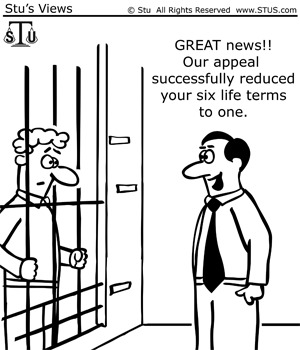
(Cartoon by Stu.)


By Doug Beaton

Posted in Practical tips | Comments closed

The nine-digit ZIP code defense

Can a creditor avoid trouble with the bankruptcy court by claiming they never received notice of the case because the notices were sent with an incorrect nine-digit ZIP code?

Not in New Hampshire, it turns out. The debtor in the Mosher case was so incensed that her homeowner association kept sending her bills and letters after she filed for bankruptcy, that she sued them and took them to a full trial before Judge Vaughn in the Bankruptcy Court in Manchester, N.H.

The homeowner’s association, called the Meadows at Chickering, defended the case by denying they had ever received any notices concerning the bankruptcy. The claimed that notices mailed to them with a ZIP code of 03110-6981 wouldn’t reach them, because they should have been addressed to 03310-7059.

The differing ZIP codes weren’t enough to save the association from some hot water, however, as Judge Vaugn was not convinced that the difference in the last four digits was enough to keep official court notices from reaching the defendants. Accordingly, he found that the homeowners association had willfully violated the automatic stay generated by the bankruptcy case, by continuing to send the debtor statements and a letter.

While the judge refused to award the debtor damages for emotional distress, he did order the Meadows at Chickering to pay $2,400.00 of the debtor’s legal fees.

When you file a bankruptcy case, violations of the automatic stay are serious business. If you have filed a bankruptcy case, but are still getting calls and letters that you don’t think are appropriate, tell your bankruptcy attorney right away; he may be able to stop the problem in its tracks.


By Doug Beaton

Posted in Bankruptcy News | Comments closed

Proposal floated to ban employers from looking at your credit reports

Should employers be able to check up on their employee’s credit reports?

A new proposal from Massachusetts state treasurer Tim Cahill would ban the practice in the Bay State. Cahill is running for governor as an independent, and as treasurer, he is not part of the legislature; hence, he would need to get a legislative sponsor in order to advance his proposal on Beacon Hill.

I have often wondered why companies would bother checking credit for the vast majority of the people they hire. Unless the prospective employee is to be given the job of counting or guarding a vast sum of money, it seems rather pointless and a waste of time.

Cahill’s proposal would prevent employers from requesting or obtaining a credit report or history for current or prospective employees. It also would prohibit the use of credit history as part of the hiring process. There would be exceptions for jobs with financial oversight.

As many as 60% of employers run credit checks on potential new hires; much or this information is wasted, and some of it may prevent deserving workers from rebuilding their lives.


By Doug Beaton

Posted in Bankruptcy News | Comments closed

“I want to file for bankruptcy, and I WANT to lose my home!”

This is a followup to yesterday’s post, where I reassured debtors that filing a bankruptcy case does not in every instance lead to the loss of a home.

Today we deal with those folks who WANT to walk away from their houses. Typically, these debtors are seriously upside-down on their mortages, and often months behind to boot. Some may have relocation plans in another part of the country. All things considered, they may be better off just letting the house go.

Bankruptcy can help these people as well, especially by eliminating any chance that lenders can chase them for a deficiency judgment months or years from now. If you just leave the house and never file a BK case, your creditors could be hounding you for years for the balance!

Bankruptcy can also avoid the unwanted tax consequences that often accompany deeds-in-lieu of foreclosure, short sales, cash-for-keys, and other bank sponsored agreements concerning the property. What you don’t want is to be hit with a massive 1099 next tax season, and not have the cash to pay the IRS on it. Bankruptcy avoids this problem, and you don’t have to worry about your real estate mess turning into a tax mess as well!.

If you are thinking of giving up your home, give me a call, and find out if a well-timed bankruptcy can avoid some of these headaches.


By Doug Beaton

Posted in Real estate | Comments closed

“If I file for bankruptcy, will I lose my home?”

“If I file for bankruptcy, I’m going to lose my home, right?”

No, not necessarily.

Most every day I confront some variation on that question, so I thought I would go over it again in some detail.

The first question to ask is does the debtor WANT to lose his home. Not so long ago, the answer was always NO, but in the current economy sometimes it doesn’t make sense to keep a seriously underwater residence. But that is a topic for another day and post. Today I will talk about the folks who do desire to stay.

The first question posed to them is ” Are you behind on your mortgage [or mortgages]? If you have managed to stay current, congratulations. You may file a Chapter 7 case and discharge unsecured debts while still keeping your home. You will, of course, have to still keep making those mortgage payments on time each month. The “secret” here is to declare any home equity exempt; in Massachusetts, this often requires filing a declaration of homestead with the county registry of deeds. New Hampshire residents can claim their homestead rights without any filings or formalities.

But what if you are behind on your payments? If you still have monthly income, you may be able to fund a Chapter 13 plan, under which you will pay of the arrears in monthly installments over several years. There are additional qualifications, so make sure you run your situation by a local bankruptcy attorney.


By Doug Beaton

Posted in Real estate | Comments closed
Call now: (978) 975 - 2608